The Stag
Die, My LoveThe Stag is the narrator’s recurring animal presence and the novel’s most powerful alternative to human intimacy. He appears as a real creature within the countryside but also as a figure formed by the narrator’s unstable perception: his hard stare, golden eye, antlers, and silent attention gradually become more emotionally authoritative than the speech of the men around her. Through him, the narrative tests whether desire can escape the human institutions that confine it, even as it remains uncertain whether the animal is an independent subject, a displaced erotic ideal, or both.
Identity and Introduction
The Stag first enters the narrator’s attention when she walks away from the house and down toward the woods during an anxious wait for The Husband. The ordinary domestic scene has become intolerable: she has been checking on The Son, imagining The Husband’s possible infidelity, and circling through fantasies of sex and abandonment. Against that background, the animal’s appearance is startlingly direct. He gives her a hard, animal stare, a look unlike anything she has received from another person. The narrator responds not with fear but with an impulse toward physical closeness, imagining that she would put her arms around him if she could. The encounter therefore establishes The Stag less as scenery than as a presence capable of interrupting the narrator’s human drama.
His importance is immediately concentrated in his gaze. The narrator does not describe a conversation, a gesture of domestication, or any practical use for the animal; what matters is that he looks at her. The Stag’s attention seems to bypass the social performances through which human relationships operate. Where The Husband’s phone calls invite repetitive questions about coffee, food, fidelity, and possible departure, The Stag offers an unreadable but absolute look. His silence does not solve the narrator’s uncertainty, yet it gives that uncertainty a form in which she can remain.
The Stag and the Woods
The Stag later appears at nightfall between the woods and the garden, visible from the house by his antlers branching like a menorah. The setting places him at a threshold: neither wholly wild and distant nor fully inside the domestic sphere, he lingers between the place of family life and the untamed landscape that repeatedly attracts the narrator. His antlers make him conspicuous from indoors, but they also mark him as an inhabitant of a different order, one not organized by the house’s routines, repairs, telephones, childcare, or marriage obligations.
The narrator experiences their meeting as an instant that is still continuing. When The Stag turns his head and reveals his pupils, she declares herself blind, transforming visual contact into an overwhelming event rather than a simple observation. The child lies on the grass between them, while The Stag tosses back his head, opens his mouth in a wide U-shape, and seems to howl or rave. His mouth becomes a pit, and after he leaves, his floating eyes and bellow remain in the narrator’s perception. The animal thus exceeds a pastoral image: he is beautiful, disturbing, and vocally present without becoming linguistically legible.
The Stag’s encounter with the child also complicates the boundary between human and animal. The Son is described as physically close to the creature’s world, watching mating capybaras and copying their movements with his small pelvis. The narrator calls her baby an animal like the rest, and The Stag becomes part of a field in which the child, the mother, and the nonhuman world can briefly share a common grammar of bodies, cries, imitation, and instinct. Yet the encounter remains asymmetrical. The narrator can only interpret The Stag’s behavior through human metaphors—howling, raving, a mouth like a pit—while the animal retains an opacity that resists her mastery.
Recognition and Desire
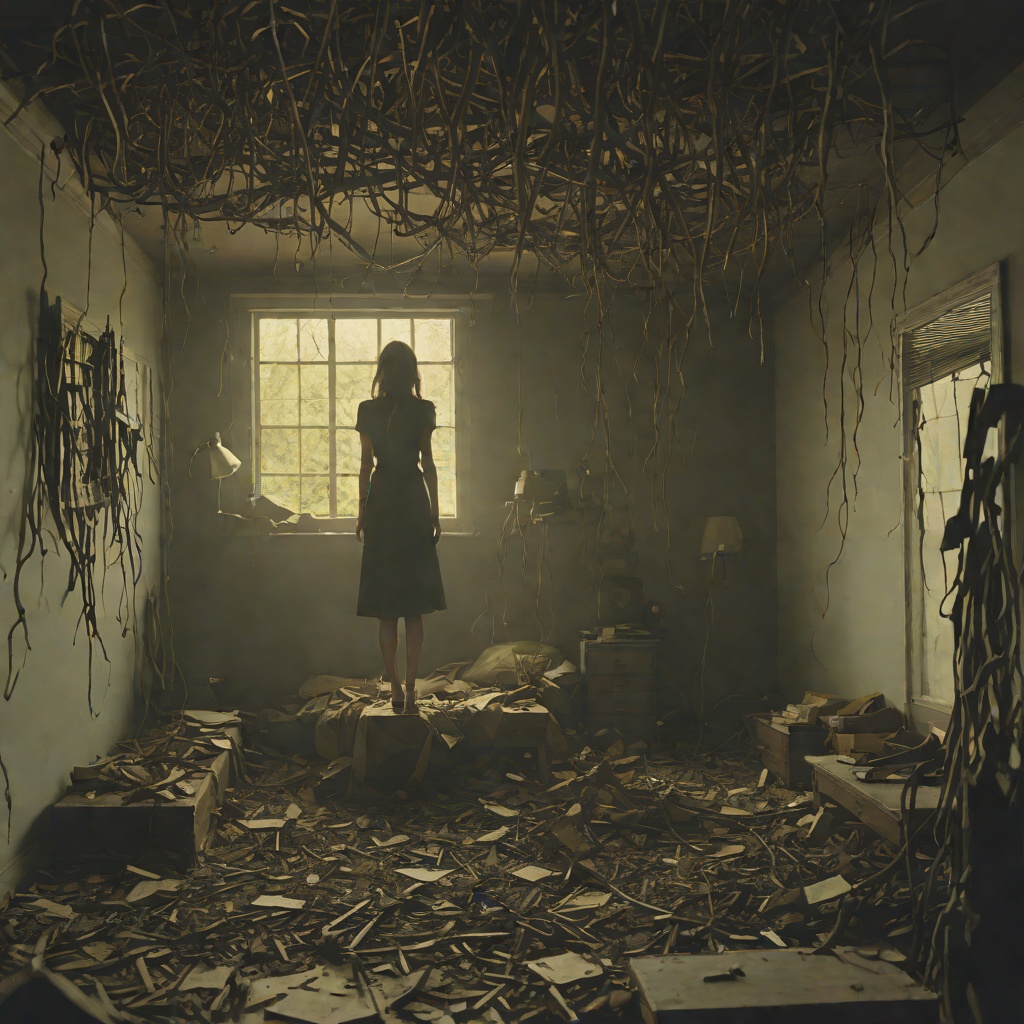
The narrator’s attachment to The Stag intensifies because she identifies him as a witness to an otherwise unrecognized inner life. After returning from the woods, she watches The Husband and The Son through the sliding glass door. The domestic pair become foggy behind her breath, and she experiences her own breathing as erasing them from her life. She is outside the household emotionally as well as physically, a stranger who cannot speak without causing offence. Against this exclusion, The Stag’s golden eye remains the thing that saves her, night after night. His significance is therefore not merely sexual or symbolic in a narrow sense: he supplies a counter-image of attention when family intimacy has become indistinguishable from entrapment.
The narrator eventually names The Stag as the man of her life, the one who can see into her infinite sadness. The claim is deliberately impossible and consequently revealing. The Stag cannot speak, promise fidelity, perform domestic labor, or enter the symbolic structure of marriage. Precisely because he does not do these things, he is not another version of The Husband. He represents a relation without the ordinary demands of human language, and the narrator contrasts him with men whose speech falls short. Her declaration that her real man is not human turns animality into an answer to the failure of human intimacy, while also exposing the depth of her estrangement from the category of the human as a social identity.
The Stag’s silence functions as a displaced language. The narrator repeatedly searches for what he is trying to tell her, but the text gives no stable message. During a later vision or episode, she sees him in the distance while hearing that adulterous wives were once punished by being forced to strip and chase a chicken around town. The social judgment attached to her desire merges with the animal world, and The Stag appears as the figure toward whom that desire is directed. Soon afterward, two figures become visible, identified by the narrator as her men, moving together in apparent happiness. The Stag’s distant presence frames the scene but does not explain it; he is the silent point around which the narrator’s erotic and marital disorientation turns.
Separation from the Human World
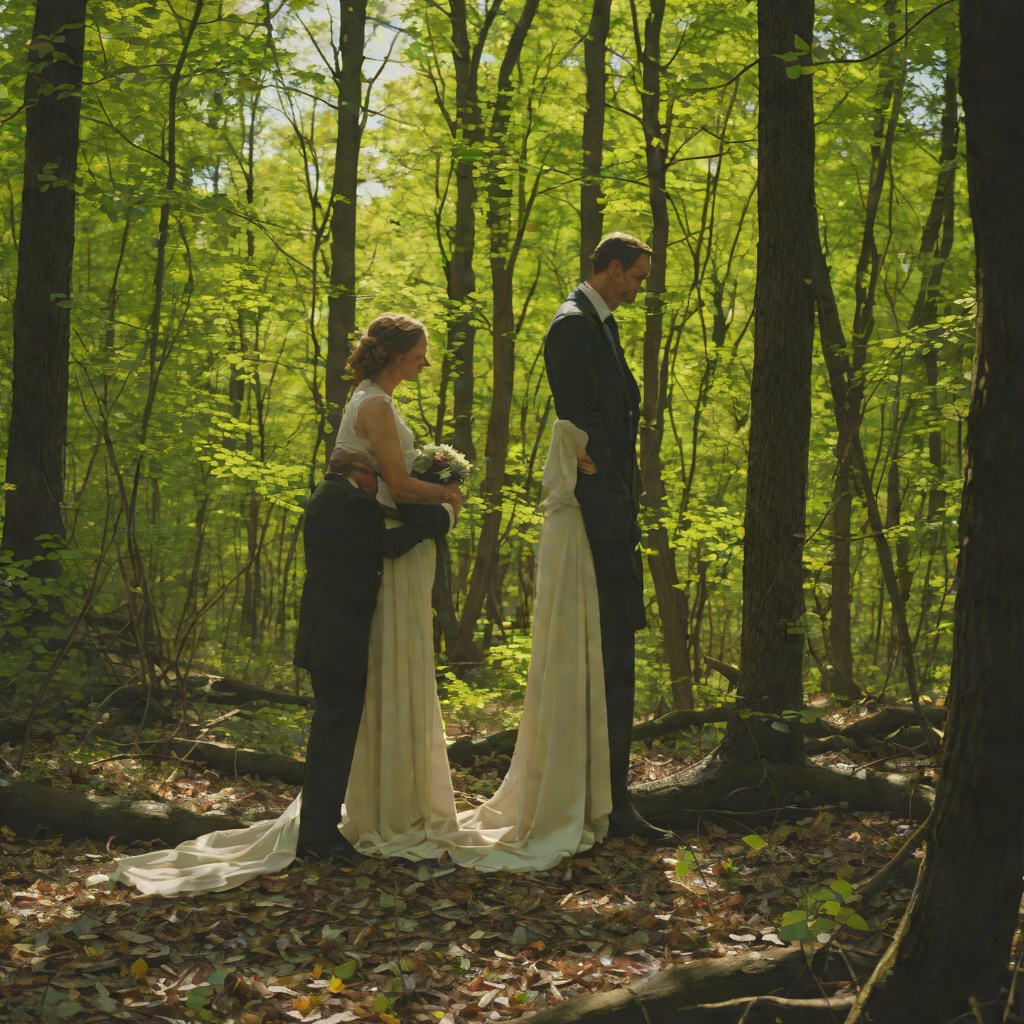
The narrator’s wedding dramatizes the social order from which The Stag stands apart. During the ceremony, the priest recites the obligations of husband and wife, including the promise to forsake all others, while the narrator’s mind runs toward a parallel life. She imagines herself covered in grass and searches desperately for The Stag and The Son amid the public celebration. The wedding party’s congratulations become animalistic and violent in her perception: guests whoop like jackals and hyenas, while hunting dogs with reptile tails whirl through the room, overturning the tablecloth and smashing glasses, bottles, and flowers. The Stag is absent from the ceremony, but his absence makes the ritual’s human claims more oppressive. Marriage attempts to name and bind the narrator, whereas her bond with The Stag remains unregistered, unsanctioned, and beyond the reach of vows.
This opposition is also visible in the narrator’s treatment of identity. She imagines The Son as a stateless child without a date of birth, last name, or social status, born not in a delivery room but in the darkest corner of the woods. The Stag’s golden eye becomes the final refuge of that fantasy of unrecorded existence. He belongs to the landscape outside official naming, and his relation to the narrator offers an image of life before or beyond the administrative and familial categories that have made her feel imprisoned.
Change and Narrative Role
The Stag does not undergo a conventional character arc. He does not speak, make a decision, or visibly alter his behavior in response to the narrator. The change occurs in the narrator’s reading of him. A creature first encountered on a walk becomes a recurring point of orientation, then an emotional partner, and finally the lost object she must seek when she returns from institutional confinement. On that return, The Husband and The Son welcome her, and the household appears renovated with a microwave, an embroidered tablecloth, and a new cordless phone. Yet the renewed domestic surface cannot contain her. The reflection of the first knife she ever dreamed of appears in her hand, and she moves toward the glass door she once crashed through before running outside to search for the tips of The Stag’s antlers.
That return to the woods shows that The Stag’s role is not erased by reunion with the family. The household has resumed its objects and routines, but The Stag remains the measure of what the house cannot provide. The narrator calls him her one and only and hopes he is still outside. Her search is simultaneously a physical act and a return to the mental landscape in which he first became visible. The antlers are enough: she does not need proof of a conversation or a reciprocal promise. She needs the possibility of seeing him again.
Narrative Significance
The Stag occupies an unstable position between independent animal presence and projection of the narrator’s desire. The evidence gives him concrete behavior—appearing at nightfall, staring, turning his head, opening his mouth, bellowing, and standing motionless with glass-like eyes—but every larger meaning reaches the reader through the narrator’s intensely subjective account. This limited focalization prevents a final decision about whether The Stag understands her, loves her, or communicates anything at all. His opacity is not a defect to be corrected; it is the condition that allows him to remain outside the disappointing economy of human speech.
At the same time, the narrative does not reduce him to a decorative metaphor. The Stag’s bodily features and repeated appearances preserve a resistant nonhuman presence. His gaze affects the narrator, but he is never fully translated into her language: his mouth is a pit, his eyes float after his departure, and his stillness resembles embalming. The animal is therefore both more and less than a romantic substitute. He is a figure through which the narrator imagines escape from marriage, nationality, motherhood, and ordinary human identity, while his silence continually exposes the limits of that imagination.
The Stag’s final significance lies in this tension. Human relationships in the narrator’s world are governed by vows, jealousy, surveillance, accusation, and the failure of language. The Stag offers none of the assurances those structures claim to guarantee, yet his gaze becomes the most durable form of recognition available to her. He stands at the edge of the woods and the garden, between the visible household and the wilderness beyond it, embodying a desire that cannot be domesticated without losing its force.